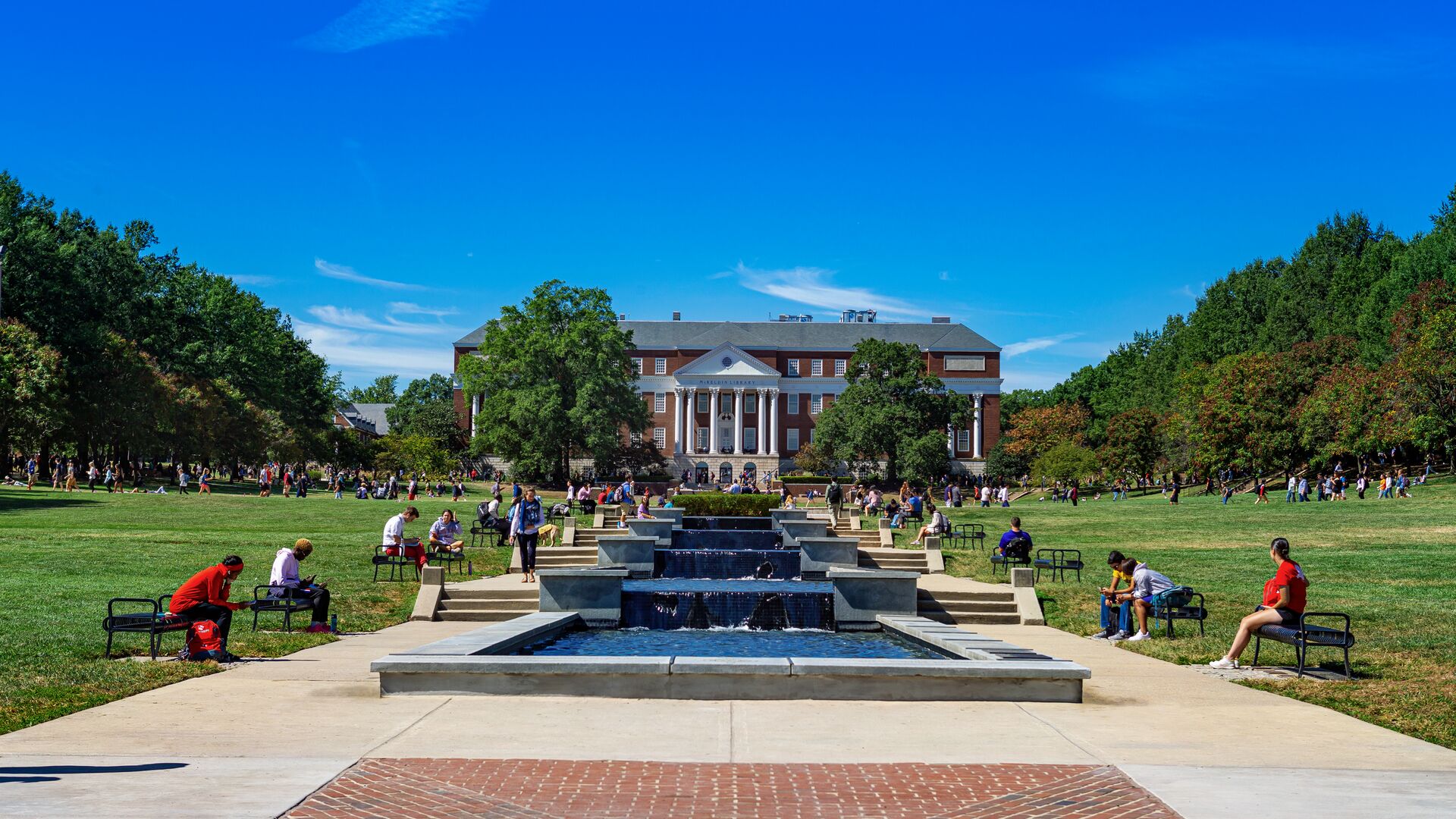
College Park is loud. If you’ve ever stood on Baltimore Avenue on a game day, you know that specific vibration—a mix of construction hum, Testudo-themed chanting, and the smell of Ledger’s pizza. It’s chaotic. It’s Maryland. Choosing a school isn’t just about looking at a US News & World Report ranking and nodding your head at a number. Honestly, the University of Maryland College Park is a weird, sprawling, brilliant beast of an institution that defies those tidy little brochures they mail to high school seniors.
People get it wrong. They think it’s just a "backup" for the Ivies or a basketball school with cool jerseys. It's so much more.
The Identity Crisis That Actually Works
Most state flagships have one "thing." Think of Virginia and its prestige, or Penn State and its football-as-religion vibe. But Maryland? We’re a bit of everything. We are a powerhouse research hub five miles from the nation’s capital, a founding member of the ACC that jumped ship for the Big Ten, and the place that basically birthed the modern Muppets. Jim Henson studied here. Think about that next time you’re stressed about a mid-term in the Armory; the guy who created Kermit sat in these same chairs.
The University of Maryland College Park doesn’t just sit in a suburb. It’s an extension of D.C.’s nervous system.
When you’re a student here, your "campus" is effectively the entire DMV. You’ve got federal agencies like NOAA, NASA Goddard, and the NIH basically in the backyard. This isn't just "flavor" for the website. It means internships that actually turn into $80,000-a-year jobs before you even graduate. If you’re in the A. James Clark School of Engineering, you aren’t just reading textbooks. You’re likely working on projects funded by Lockheed Martin or Northrop Grumman. It's intense.
Is the "College" Part Too Big?
Let's talk about the size. It’s huge. Over 40,000 students call this place home. If you’re the type of person who needs a professor to know your middle name by Tuesday, you might struggle at first. You’re going to be in lecture halls with 300 other people in McKeldin or the Brendan Iribe Center. It's easy to feel like just another UID number.
But there’s a trick to it.
You find your "micro-college" within the University of Maryland College Park. Whether that’s the Jimenez-Porter Writers' House or the QUEST Honors Program, you have to shrink the campus yourself. If you don't join a club or a niche academic track, the scale of the place will eat you alive. I've seen it happen. Students who stay in their dorm rooms at Pyon-Chen or Johnson-Whittle (the fancy new ones, lucky them) and never branch out end up hating the "big school" feel.
The Research Monster in the Room
Maryland is a Tier 1 research university. That sounds like academic fluff, but here’s what it actually means for your daily life: the professors are often more famous for what they do outside the classroom than what they teach inside it. You might have a professor who’s literally advising the White House on cybersecurity or a sociologist who’s the leading expert on urban wealth gaps.
- The Quantum Leap: We are basically the "Quantum Capital" of the country. With the Joint Quantum Institute, UMD is doing stuff with physics that most of us can't even pronounce.
- The Smith School: If you’re into business, the Robert H. Smith School of Business is cutthroat but effective. They don't just teach accounting; they teach networking as a survival skill.
- The Diamondback: Our student newspaper isn't just a hobby. It’s a legitimate newsroom that has been holding the administration accountable for decades.
What No One Tells You About the "Experience"
Rub the nose. That’s the rule.
There’s a bronze statue of Testudo—our Diamondback terrapin mascot—in front of McKeldin Library. During finals week, it becomes an altar. Students leave offerings. I’m not talking about pennies. I’m talking about half-eaten pizzas, rotisserie chickens, old TVs, and occasionally, a stray scooter. It’s superstitious and slightly gross, but it’s the glue that holds the student body together when everyone is caffeinated to the point of vibration.
And then there's the flag. Marylanders have an unhealthy obsession with their state flag. It’s everywhere. It’s on the football helmets, it’s on the socks, it’s probably tattooed on half the Greek life population. It’s a weirdly fierce pride that you don't see in many other states. You’ll find yourself unironically saying "Fear the Turtle" within three months. It’s inevitable.
The Big Ten Transition: Ten Years Later
It’s been over a decade since Maryland left the ACC. Some older alumni still grumble about it. They miss the Duke rivalry. They miss the tobacco road trips. But honestly? Moving to the Big Ten saved Maryland’s athletic department from a financial crater.
The Big Ten Network money allowed for the construction of the Jones-Hill House—a football facility that looks like something out of a sci-fi movie. It also raised the academic profile of the school through the Big Ten Academic Alliance. Now, we’re competing for grants and researchers alongside Michigan, Northwestern, and Ohio State. It shifted the gravity of the school from a regional Southern power to a national powerhouse.
Plus, there is nothing like a basketball game at the Xfinity Center when it's sold out. The "Wall" of students is terrifying for opposing teams. It’s loud, it’s vertical, and it’s one of the best atmospheres in college sports. Period.
The Real Cost and Value
Let’s be real: college is expensive. Even for in-state students, the University of Maryland College Park isn't "cheap." But compared to the $85,000 price tags at private schools like GWU or Georgetown just down the road, UMD is a bargain for the ROI you get.
The Computer Science department here is world-class. If you can survive the weed-out courses, you’re basically guaranteed a job in the Northern Virginia tech corridor. The same goes for the Philip Merrill College of Journalism. It’s one of the few places left that treats journalism like a trade, putting students in real-world bureaus in Annapolis and D.C.
Navigating the Campus (Literally)
If you hate walking, don't come here. The campus is hilly and expansive. The "M" circle is beautiful, sure, but walking from the South Campus Commons to a lab on the North side in August humidity is a rite of passage that involves a lot of sweat.
The Purple Line light rail construction has been a nightmare for years, let's be honest. It’s torn up the heart of campus, redirected buses, and made getting to class a bit of an obstacle course. But once it’s finished, it’s going to change the game. It’ll connect the university directly to the New Carrollton and Bethesda areas, making the campus even more integrated into the D.C. metro system.
Actionable Steps for Prospective Terps
If you are actually looking at the University of Maryland College Park as your future home, don't just take the official tour. The official tour is sanitized. It’s boring.
- Visit the hidden spots: Go to the Dairy Jump for some Maryland-made ice cream. Check out the basement of the Stamp Student Union. Walk through the Garden of Reflection and Remembrance behind the Chapel.
- Audit the major: Don’t just look at the general stats. Look at the specific requirements for the "LEP" (Limited Enrollment Programs). Business, Engineering, and Comp-Sci are harder to get into once you’re already on campus than they are when you apply as a freshman.
- Check out the "Discovery District": Walk through the area near the Hotel at UMD. This is where the big tech startups and research partnerships are. It’s the future of the university’s economy.
- Talk to a real student: Find someone who isn't wearing a "Tour Guide" polo. Ask them about the Wi-Fi in the older dorms (it can be spotty) or the best place to eat in Route 1 (it’s Marathon Deli, don't let anyone tell you otherwise).
Maryland isn't just a school. It’s a massive, complex, sometimes frustrating, but ultimately rewarding ecosystem. It demands that you be a self-starter. If you wait for opportunities to knock on your door at a school this size, you’ll be waiting a long time. But if you go out and grab them, there is almost no limit to what you can do. From the heights of the Discovery District to the tradition of the Maryland Day festivities, this university represents the best of what a public research institution can be.
The turtle moves slow, but it's hard to stop.