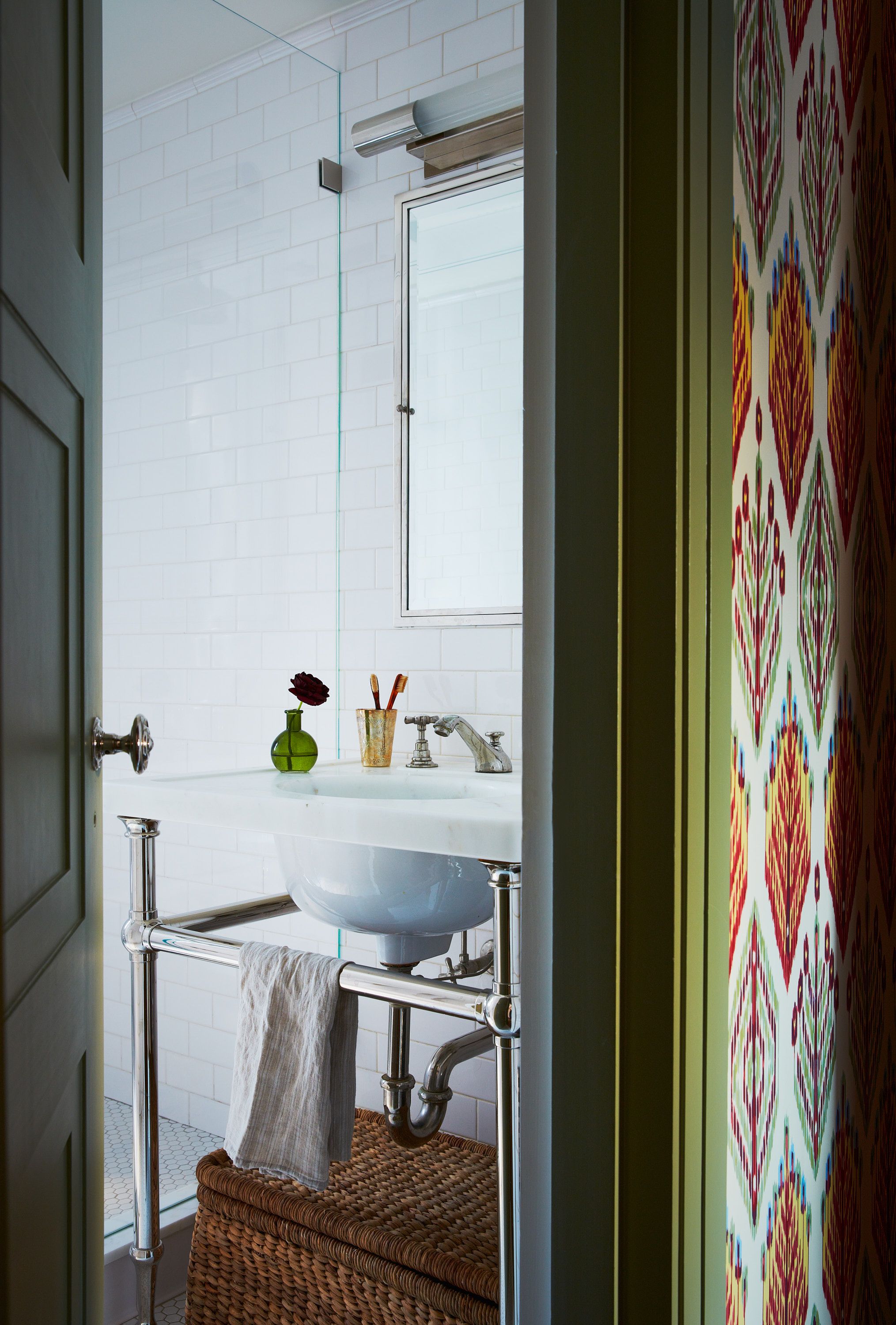
You've been told for years that white makes a room look bigger. It's the standard advice. Designers, realtors, and your DIY-obsessed aunt all swear by it. But honestly? In a tiny windowless powder room, white usually just looks dingy. It’s gray. It’s sterile. It feels like a doctor’s office waiting room.
That is why moody small bathroom ideas are taking over. Instead of fighting the lack of space, you lean into it. You embrace the shadows. By using deep, saturated tones, the walls seem to recede. The corners disappear. Suddenly, your cramped five-by-eight-foot bathroom feels like a high-end lounge in a Soho hotel. It’s a vibe.
It’s also about psychology. Small rooms are meant to feel intimate. When you drench a small space in charcoal, navy, or forest green, you create a "jewelry box" effect. It’s intentional. It’s bold. Most importantly, it’s one of the few places in your home where you can take a massive design risk without it feeling overwhelming. If you paint a 300-square-foot living room black, it might feel like a cave. If you do it to a tiny bathroom, it’s a masterpiece.
The Science of Dark Colors in Small Spaces
Most people get the "small room" rule wrong because they don't understand how light works. Reflective light needs a source. If you have a tiny bathroom with no windows, there is no natural light to bounce off those white walls. You’re just left with shadows in the corners that make the room feel cramped and unfinished.
According to color theory experts like Abigail Ahern, dark colors blur the boundaries of a room. When the walls, baseboards, and even the ceiling are painted the same dark hue, your eye can't easily find where one surface ends and another begins. This creates an illusion of infinity. It’s weirdly expansive.
Forget the "Accent Wall"
Please, just stop with the single dark wall. In a small bathroom, an accent wall often cuts the space in half visually. It makes the room look choppy. If you're going for a moody look, you have to go all in. This is called "color drenching." You paint the walls, the trim, the back of the door, and yes, sometimes even the ceiling.
Think about it this way: if you wear a black suit with white shoes, your feet are the first thing people see. If you want the focus to be on the overall silhouette, you keep the colors consistent. The same applies to your bathroom. When everything is unified, the room feels cohesive and significantly more expensive than it actually was to renovate.
💡 You might also like: The Betta Fish in Vase with Plant Setup: Why Your Fish Is Probably Miserable
Textures That Keep Dark Bathrooms From Feeling Flat
One big fear people have with moody small bathroom ideas is that the room will end up looking like a literal hole in the ground. That happens when you only use flat paint. Texture is the "secret sauce" here. You need materials that catch the light, even if that light is just coming from a single 40-watt bulb.
- Zellige Tiles: These are handmade Moroccan tiles. No two are exactly alike. They have ripples, chips, and varying shades. When you use a dark green or navy Zellige tile, the uneven surface reflects light in a thousand different directions. It looks like water.
- Limewash Paint: If you don't want to tile, use limewash. Brands like Bauwerk or Portola Paints have made this popular again. It has a chalky, mottled finish that looks like an old Italian villa. It adds "movement" to the walls.
- Reeded Glass: Use this for your shower door or cabinet fronts. It obscures the view but plays with light beautifully, adding a layer of sophistication that flat glass just can't match.
I once saw a bathroom in a Brooklyn brownstone that used matte black hexagonal floor tiles paired with a glossier charcoal wall. The contrast wasn't in the color—it was in the sheen. It looked incredible.
Lighting: The Make-or-Break Factor
You cannot use a single overhead "boob light" in a moody bathroom. You just can't. It will wash out the depth and make the dark colors look muddy rather than moody. Lighting in a dark space needs to be intentional and layered.
Sconces are your best friend. Don't put them above the mirror; put them on either side of it at eye level. This prevents harsh shadows on your face. Look for warm-toned bulbs (around 2700K). You want a glow, not a glare.
Hidden LEDs. A popular trick right now is putting an LED strip under a floating vanity or behind a mirror. This creates a "halo" effect. It makes the heavy, dark vanity look like it’s floating in space. It adds a sense of lightness to a room that is otherwise visually heavy.
Dimmer switches. This is non-negotiable. A moody bathroom should be able to transition from "getting ready for work" bright to "relaxing evening soak" dim. If you can't dim your lights, you've missed the point of the aesthetic.
📖 Related: Why the Siege of Vienna 1683 Still Echoes in European History Today
Metals and Hardware: The Jewelry
When you have a dark backdrop, your hardware stands out like jewelry. This is where you can really define the style.
If you go with unlacquered brass, the bathroom feels classic and timeless. Brass pops against navy or hunter green. Over time, it develops a patina that looks even better. On the flip side, if you use matte black hardware on dark gray walls, you get a ultra-modern, "stealth" look that is very masculine and sleek.
Don't forget the drain. People always forget the shower drain and the P-trap under the sink. If you have an open vanity, that chrome pipe is going to ruin your moody vibe. Match your plumbing to your faucet. It’s a small detail that makes a massive difference in how "finished" the room feels.
Real World Example: The "Speakeasy" Powder Room
I recently spoke with a homeowner who converted a tiny closet under her stairs into a powder room. It was barely 15 square feet. Most people told her to paint it light blue to make it feel "airy." She ignored them.
She used a deep burgundy floral wallpaper with a black background. She painted the ceiling a matching matte black. She installed a single, low-hanging pendant light with an Edison bulb. The result? Every single person who visits her house comments on that bathroom. It feels like a secret speakeasy. It’s cozy, it’s private, and it feels intentionally small rather than accidentally cramped.
That’s the core of successful moody small bathroom ideas. It’s about making the smallness feel like a luxury feature rather than a floorplan flaw.
👉 See also: Why the Blue Jordan 13 Retro Still Dominates the Streets
Dealing With Maintenance (The Honest Truth)
Let's be real for a second. Dark bathrooms show things that white bathrooms hide. Soap scum is white. Toothpaste spit is white. Dust is often light-colored. On a black matte countertop, you will see every single drop of dried water.
If you aren't the type of person who wipes down the sink after every use, maybe don't go with a solid black vanity top. Instead, choose a dark soapstone or a marble with heavy veining. The natural patterns in the stone will hide the "life" that happens in a bathroom.
Also, dark paint shows scuffs more easily. Use a high-quality finish. A "Dead Flat" finish looks amazing but is a nightmare to clean. An eggshell or satin finish is usually the sweet spot for bathroom walls because you can actually wipe them down without leaving a permanent mark.
Common Pitfalls to Avoid
- Too many patterns. If your walls are dark and moody, keep the floor relatively simple, or vice versa. If you have a busy wallpaper AND a busy floor tile AND a busy rug, the small room will start to feel claustrophobic instead of cozy.
- Skimping on the mirror. In a dark room, you want a large mirror. It’s not just for checking your hair; it reflects whatever light you do have. A huge, floor-to-ceiling mirror in a tiny dark bathroom can double the perceived depth of the room.
- Ignoring the "Fifth Wall." The ceiling is often left white out of habit. In a moody room, a white ceiling can feel like a lid on a box. Paint it the same color as the walls, or a shade or two darker. It sounds scary, but it actually makes the ceiling feel higher because you lose the "line" where the wall ends.
Actionable Steps to Start Your Transformation
Don't just jump in and buy five gallons of black paint. Start small.
- Test your colors. Buy three or four samples of "near-black" colors. Look at them at 8 AM, 2 PM, and 9 PM. A color that looks like a beautiful forest green in the morning might look like a muddy swamp at night under artificial light.
- Swap the hardware first. If you aren't ready to paint, change your faucet and cabinet pulls to a warm gold or deep bronze. See how that changes the vibe.
- Upgrade the textiles. Buy some high-heavy towels in a charcoal or chocolate brown. Add a dark, textured bath mat. This is a low-stakes way to see if you actually like the "heavy" feeling of dark colors.
- Commit to the "Box" feel. Once you're ready, paint the trim and the ceiling. If you're going to go moody, don't go halfway. The magic happens when the whole room is enveloped in the color.
Moody bathrooms aren't just a trend; they are a solution for difficult spaces. They prove that you don't need a massive footprint to have massive style. By leaning into the shadows, using rich textures, and mastering your lighting, you turn a forgotten corner of your home into its most talked-about feature. Stop trying to make your small bathroom look big. Start making it look incredible.