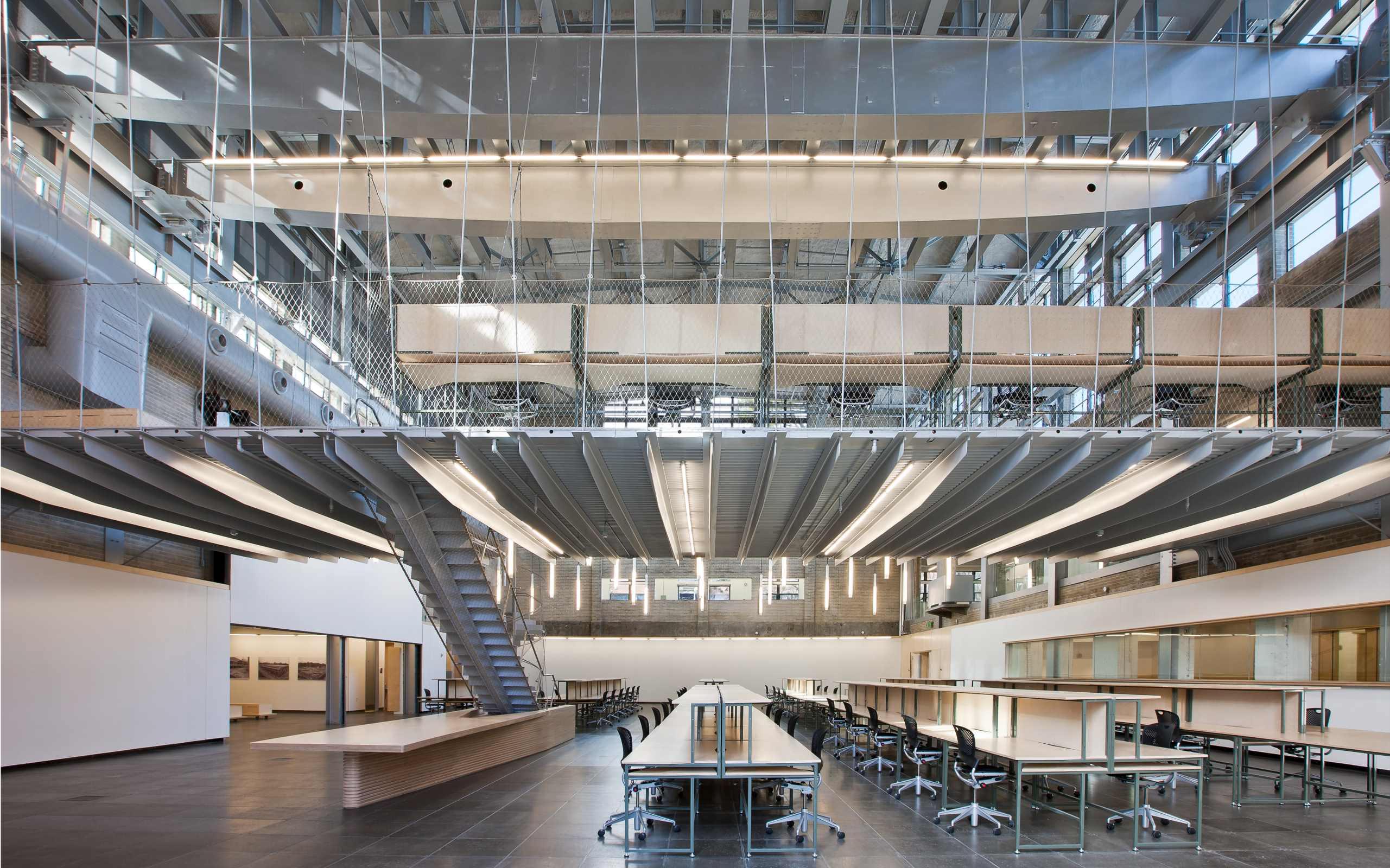
Walk into the Jesse W. Mason Building on a Tuesday afternoon and you’ll smell it immediately. It isn't that sterile, "new tech" scent you get over at the Coda building or the Kendeda Building. No, Mason smells like concrete dust, old hydraulic fluid, and maybe a little bit of desperation from a junior trying to finish a structural analysis lab. It’s a building that works for a living.
Technically known as the Jesse W. Mason Building, this mid-century slab of architecture is the undisputed home base for the School of Civil and Environmental Engineering (CEE) at the Georgia Institute of Technology. Most students just call it "Mason." If you're looking for the glitz and glamour of Silicon Valley-style glass walls, you’re in the wrong place. But if you want to see where the people who keep our bridges from falling down actually learn their craft, this is the epicenter.
The Mason Building has been sitting on the corner of Atlantic Drive and Ferst Drive since 1969. It’s named after Jesse W. Mason, who was a pretty big deal at Tech—he served as the Dean of Engineering from 1948 to 1966. Back then, the building was a state-of-the-art marvel. Today? It’s a fascinating mix of "vintage" grit and high-end modern research. It’s a place where the elevators are notoriously slow, yet the laboratories inside house some of the most sophisticated seismic and materials testing equipment in the Southeast.
Honestly, the building is a bit of a labyrinth. You've got the main instructional areas, but then there's the high-bay lab. That’s where the real magic happens.
What’s Actually Inside the Mason Building?
A lot of people think engineering is just sitting behind a laptop running CAD simulations. Mason proves that’s a lie. The structural engineering labs here are massive. We’re talking about cranes that can lift tons of steel and hydraulic actuators that can snap concrete beams like toothpicks just to see where they fail.
The ground floor and the basement levels are essentially industrial workshops. You’ve got students wearing hard hats and safety glasses, mixing specialized concrete batches or testing the "creep" of new composite materials. It’s loud. It’s messy. It’s exactly what engineering should be.
But it isn't all just heavy lifting. Over the years, Georgia Tech has poured millions into renovating parts of Mason to keep up with the times. The Digital Fabrication Lab and various computational spaces have sprouted up. You might see a student using a VR headset to walk through a 3D model of a wastewater treatment plant right next to a guy who is covered in red clay from a geotechnical soil sampling project.
The building also houses the CEE main offices. If you need to talk to an advisor or find a professor specializing in transportation systems or fluid mechanics, you’re heading to the upper floors. These offices have that classic "academic" feel—walls lined with thick textbooks and whiteboards covered in differential equations that look like a foreign language to the uninitiated.
The Famous (and Infamous) High-Bay Lab
You can't talk about the Mason Building without mentioning the high-bay area. It’s the soul of the place. This is a multi-story open space designed specifically to handle large-scale structural components.
- Ever wondered how a skyscraper stays up during a hurricane?
- They test the joints here.
- Want to see how recycled plastics can be integrated into road barriers?
- That happens here too.
The high-bay is a reminder that civil engineering is a physical discipline. It’s about the weight of the world. Standing on the balcony looking down into the lab, you realize that the research happening in this 1960s-era building is literally shaping the infrastructure of the 2030s and 2040s.
Why Location Matters at Georgia Tech
Mason sits in a prime spot on the Atlanta campus. It’s right across from the Van Leer building (Electrical Engineering) and just a short walk from the Student Center. This "engineering row" creates a specific kind of energy. Between classes, the sidewalk outside Mason is a sea of North Face backpacks and students debating the merits of various bridge designs.
Because it’s right on Ferst Drive, it’s also a landmark for the Stinger buses. If you’re a freshman lost on campus, "the Mason building" is one of those reliable anchors. It’s a brutalist-adjacent landmark that doesn't try to be pretty, which is kind of its charm. It’s functional. It’s sturdy. It’s Georgia Tech.
The Sustainable Evolution of an Old Giant
There is a bit of irony in an old building like Mason housing the Environmental Engineering wing. How do you teach 21st-century sustainability in a building built when lead paint was still a thing?
Well, they’ve adapted. Georgia Tech has been aggressive about integrating "living labs" into their existing structures. Inside Mason, you’ll find sensors monitoring air quality and energy usage. The curriculum has shifted too. It’s no longer just about building the biggest dam; it’s about how that dam affects the local ecosystem and the carbon footprint of the concrete used to build it.
The School of Civil and Environmental Engineering at Tech is consistently ranked in the top three nationally by U.S. News & World Report. That kind of prestige doesn't come from fancy buildings alone; it comes from the work done inside them. Mason has seen thousands of graduates go on to design the tunnels under Manhattan, the airports in Dubai, and the water systems in rural Georgia.
Survival Tips for the Mason Building
If you're a student or a visitor heading to Mason, there are a few things you basically have to know.
- The Basement is a Time Capsule: If you want to see the "real" Tech, wander down to the lower labs. It feels like 1974 in the best way possible.
- The Study Spaces are Gold: While the library is always packed, Mason has these little pockets of lounge areas and computer labs that are usually quieter. They’re perfect for when you need to grind out a problem set at 9:00 PM.
- Check the High-Bay Schedule: If you’re lucky enough to be there during a major structural test, find a window. Watching a massive steel girder buckle under 200,000 pounds of pressure is weirdly satisfying.
- Parking is a Nightmare: Don't even try to park right outside unless you have a specific permit. Use the visitor lots near the CRC and walk. You’ll appreciate the campus more anyway.
What Most People Get Wrong About Mason
There’s a misconception that because Mason is "old," the tech inside is outdated. That couldn't be further from the truth. In the last few years, the building has integrated advanced robotics for construction automation and high-speed imaging for fracture mechanics.
People also assume civil engineering is just "roads and bridges." Walk through the halls of Mason and you’ll see research on smart cities, autonomous vehicle integration, and even the logistics of Mars colonies. The building might be made of old-school concrete, but the ideas inside are futuristic.
It’s also surprisingly social. Because CEE is such a grueling major, the students in Mason tend to form tight bonds. The "Mason vibe" is one of shared struggle and mutual respect. It’s common to see groups of five or six people huddled around a single laptop in the hallways, arguing about a fluid dynamics simulation.
Looking Forward: The Future of the Mason Building
As Georgia Tech continues to expand—with the new Tech Square phases and the massive growth in West Campus—Mason remains a tether to the institute’s core identity. There are always rumors of more renovations or even a new "Mason II," but for now, the original building stands firm.
It represents a bridge between the physical world and the digital one. In an era where everyone wants to work in "the cloud," the people in Mason are focused on the ground beneath our feet. They’re the ones making sure the cloud’s data centers don't sink into the soil.
If you want to understand the DNA of Georgia Tech, you have to spend an hour in the Mason Building. Listen to the hum of the HVAC, look at the cracked asphalt in the testing yards, and watch the students who are clearly exhausted but also clearly brilliant. It’s not the prettiest building on campus, but it might be the most important.
Practical Steps for Prospective Students or Visitors
- Visit During the CEE Open House: If you’re a high schooler, this is the best time to get into the restricted lab areas. They often run demonstrations that are way cooler than the standard campus tour.
- Connect with the CEE Career Expo: This usually happens nearby and is the best way to see how the work in Mason translates into six-figure salaries at firms like AECOM, Kimley-Horn, or Brasfield & Gorrie.
- Check the Research Portals: Before visiting a specific professor, look at the CEE website to see which floor their lab is on. It’ll save you twenty minutes of wandering through the stairwells.
- Grab Coffee at the Student Center First: There isn't a café inside Mason, and you’re going to want caffeine before you dive into a three-hour structural lab.
The Mason Building is more than just a collection of classrooms. It’s a proving ground. It’s a place where theoretical math meets the unforgiving reality of physics. Whether you’re a student, an alum, or just someone interested in how the world is built, Mason is a testament to the fact that some of the most important work happens in the most unassuming places.